The Core Principle
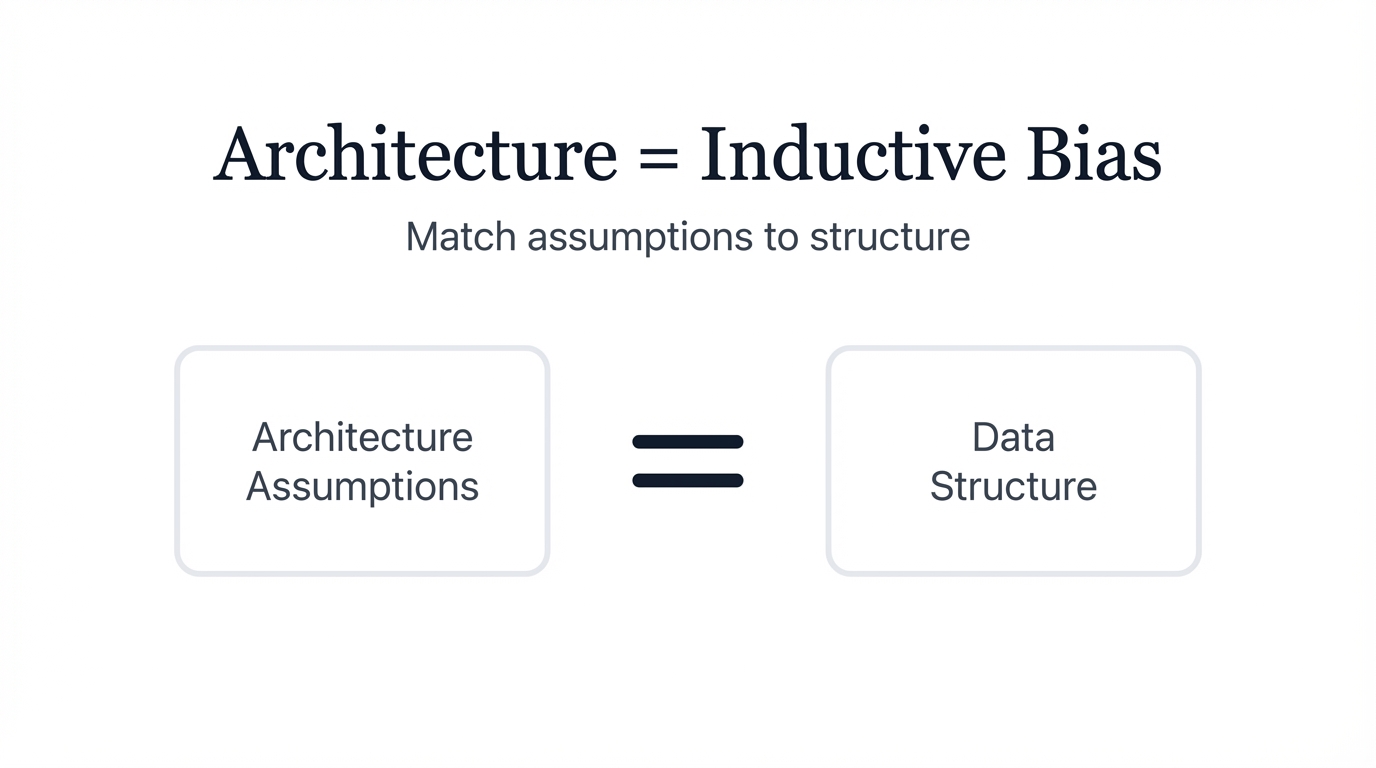
Architecture = Inductive Bias. Match your architecture's assumptions to your data's structure.
| Data Structure | Architecture Assumes | Use | Watch For |
|---|---|---|---|
| Grid/Spatial (images) | Nearby elements correlate | CNN | Misses global context |
| Sequential (text, time) | Order matters | Transformer/RNN | Cost/latency explosion |
| Relational (networks) | Explicit relationships | GNN | Graph construction errors |
| Tabular (spreadsheets) | Minimal structure | Trees → MLP | High data requirements |
| Multiple types | Separate encoders needed | Multimodal | Complexity without gain |
Quick Decision by Modality
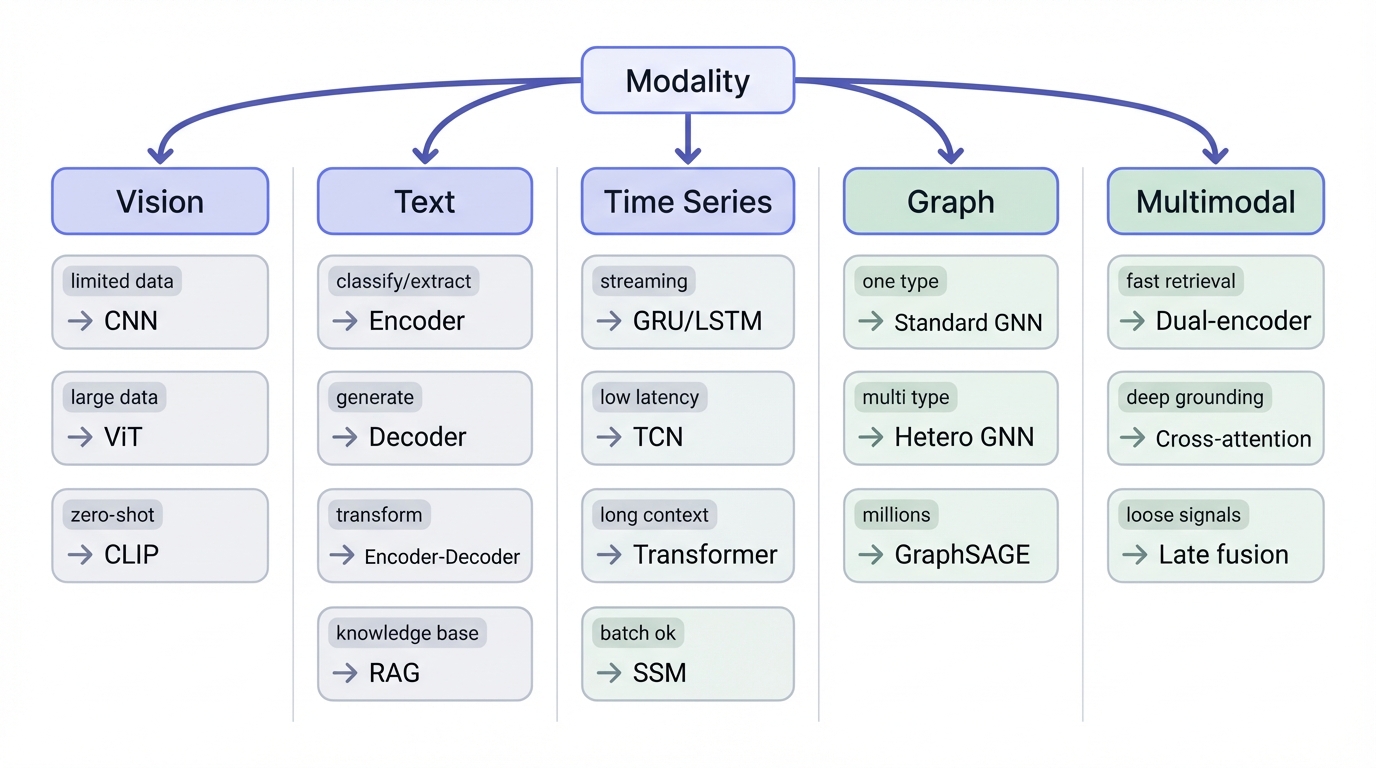
Vision
- Limited data / edge deployment → CNN (ResNet, EfficientNet)
- Large data + pretrained available → ViT
- Zero-shot / retrieval / similarity → CLIP-style embeddings
Text
- Understand / classify / extract → Encoder (BERT-style)
- Generate / complete → Decoder (GPT-style)
- Transform (translate, summarize) → Encoder-Decoder (T5)
- Large knowledge base → RAG (retrieval + generation)
Time Series
- Streaming + low latency → GRU/LSTM or TCN
- Batch OK + long context → Transformer or SSM
Graph
- One node/edge type → Standard GNN (GCN, GAT)
- Multiple types → Heterogeneous GNN
- Millions of nodes → GraphSAGE with sampling
Multimodal
- Fast retrieval/matching → Dual-encoder (CLIP-style)
- Deep grounding (VQA) → Cross-attention
- Loosely coupled signals → Late fusion
Data Quantity Rules of Thumb
| Samples | Approach |
|---|---|
| < 1,000 | Classical ML. Heavy transfer learning if neural. |
| 1,000-10,000 | Transfer learning essential. Fine-tune pretrained. |
| 10,000-100,000 | Most architectures viable with pretrained start. |
| 100,000+ | Training from scratch becomes reasonable. |
The Five Principles
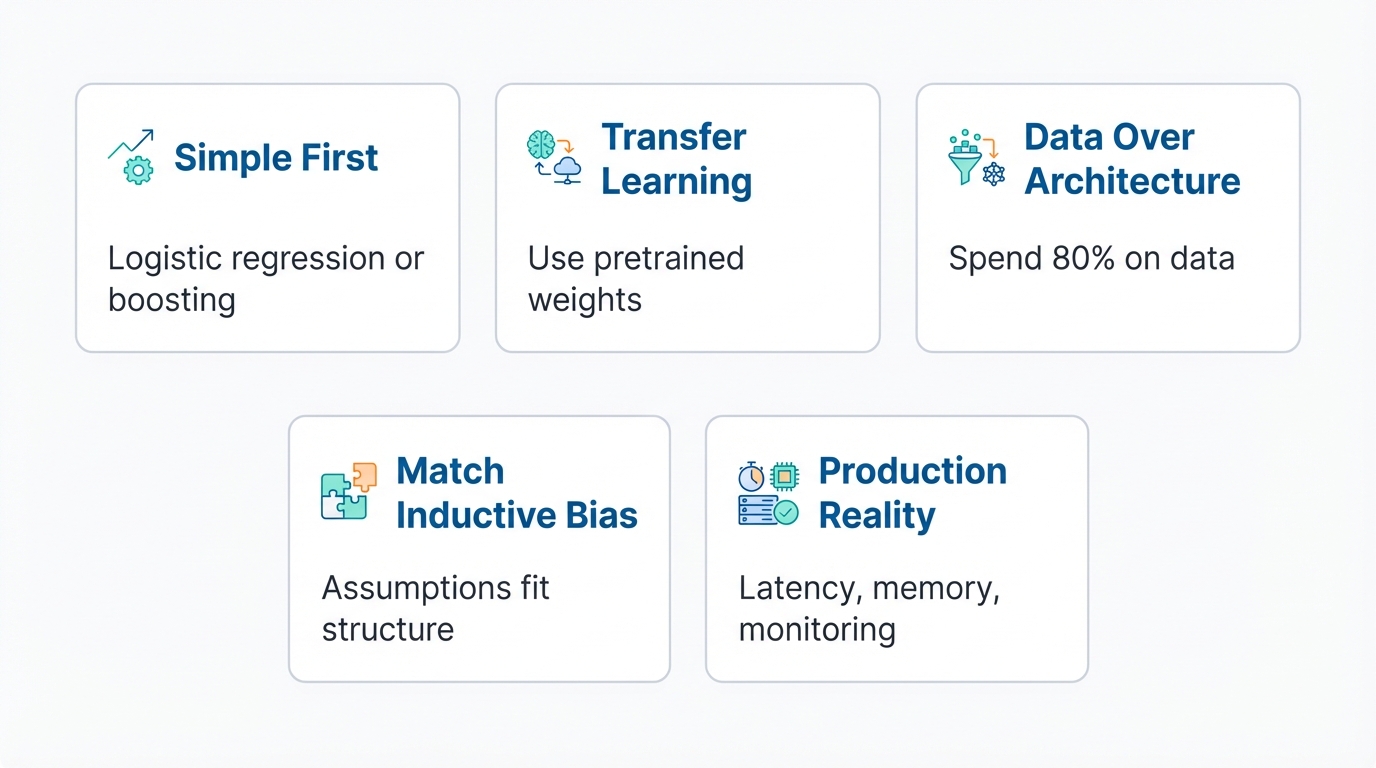
- Simple First: Try logistic regression or gradient boosting before neural networks.
- Transfer Learning Default: Never train from scratch if pretrained weights exist.
- Data Over Architecture: The best architecture can't fix bad data. Spend 80% on data quality.
- Match Inductive Bias: Choose architectures whose assumptions match your data's true structure.
- Production Reality: Consider latency, memory, and monitoring from the start.
Before You Start: Model Brief
Answer these before choosing:
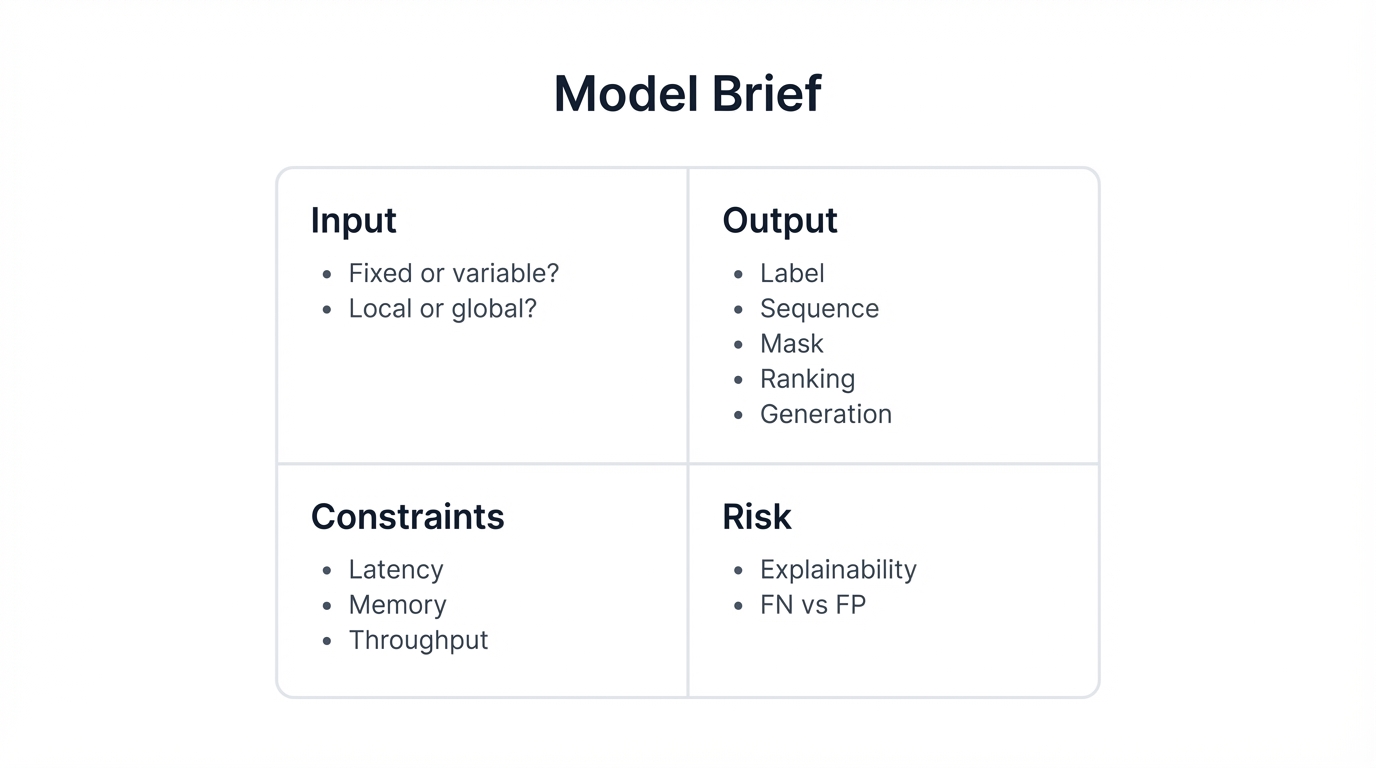
Input: Fixed or variable size? Local or global signal?
Output: Label, sequence, mask, ranking, or generation?
Constraints: Latency requirement? Memory budget? Throughput needs?
Risk: Explainability required? False negative vs false positive tolerance?
Common Mistakes
| Mistake | Reality |
|---|---|
| "Transformers are always best" | Wasteful for tabular, small vision, edge |
| Ignoring classical ML for tabular | XGBoost/LightGBM often wins |
| Training from scratch | Fine-tuning needs 100x less data |
| Deeper = better | Diminishing returns, overfitting risk |
| Adding modalities "because it might help" | Complexity without signal = noise |
Production Checklist
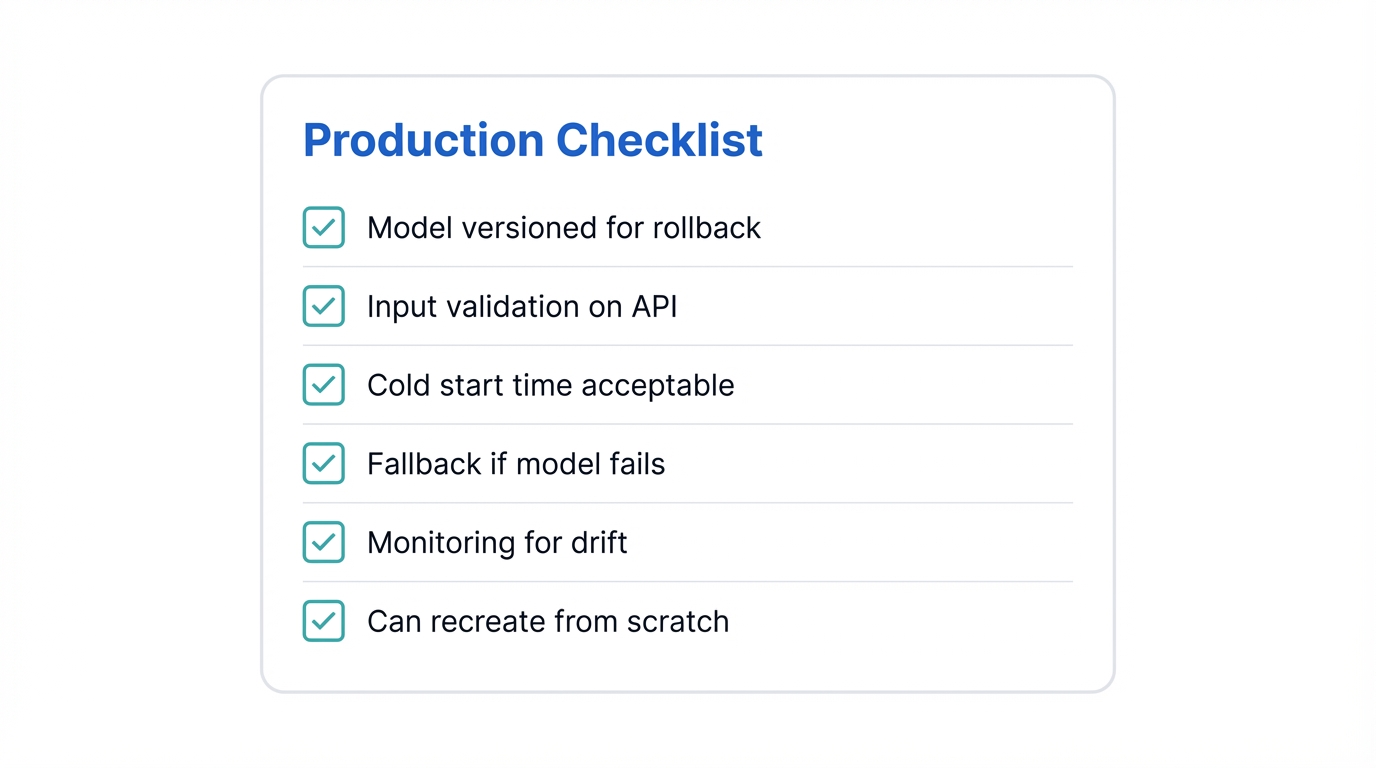
- ☐ Model versioned for rollback?
- ☐ Input validation on API?
- ☐ Cold start time acceptable?
- ☐ Fallback if model fails?
- ☐ Monitoring for drift?
- ☐ Can recreate from scratch if needed?
Optimization Options
| Technique | Result |
|---|---|
| Quantization (float32 → int8) | 4x smaller, 2-4x faster |
| Pruning | Remove near-zero weights |
| Distillation | Small student mimics large teacher |
Full Guide
For comprehensive coverage with worked examples and deep-dives into each architecture family:
perfecXion.ai